Judith Copithorne: A Portrait of Nothing

In 2009–2010, I was mesmerized by Judith Copithorne’s work during my graduate studies with Canadian poet Professor Gregory Betts. Greg (and his circle of remarkable colleagues) introduced me to a visual world I previously knew almost nothing about. It was a creatively life-changing experience, and I found myself hungrily chasing down both historical and then-current works. As an artist whose career has largely focused on drawing, I was naturally drawn to Judith’s early works, which feature a confluence of serpentine drawn and written elements. There was something “different” about her work—something that stood apart from much of what I was pursuing at the time—and I kept digging. Eventually, I encountered her 2009 work The Letter O.
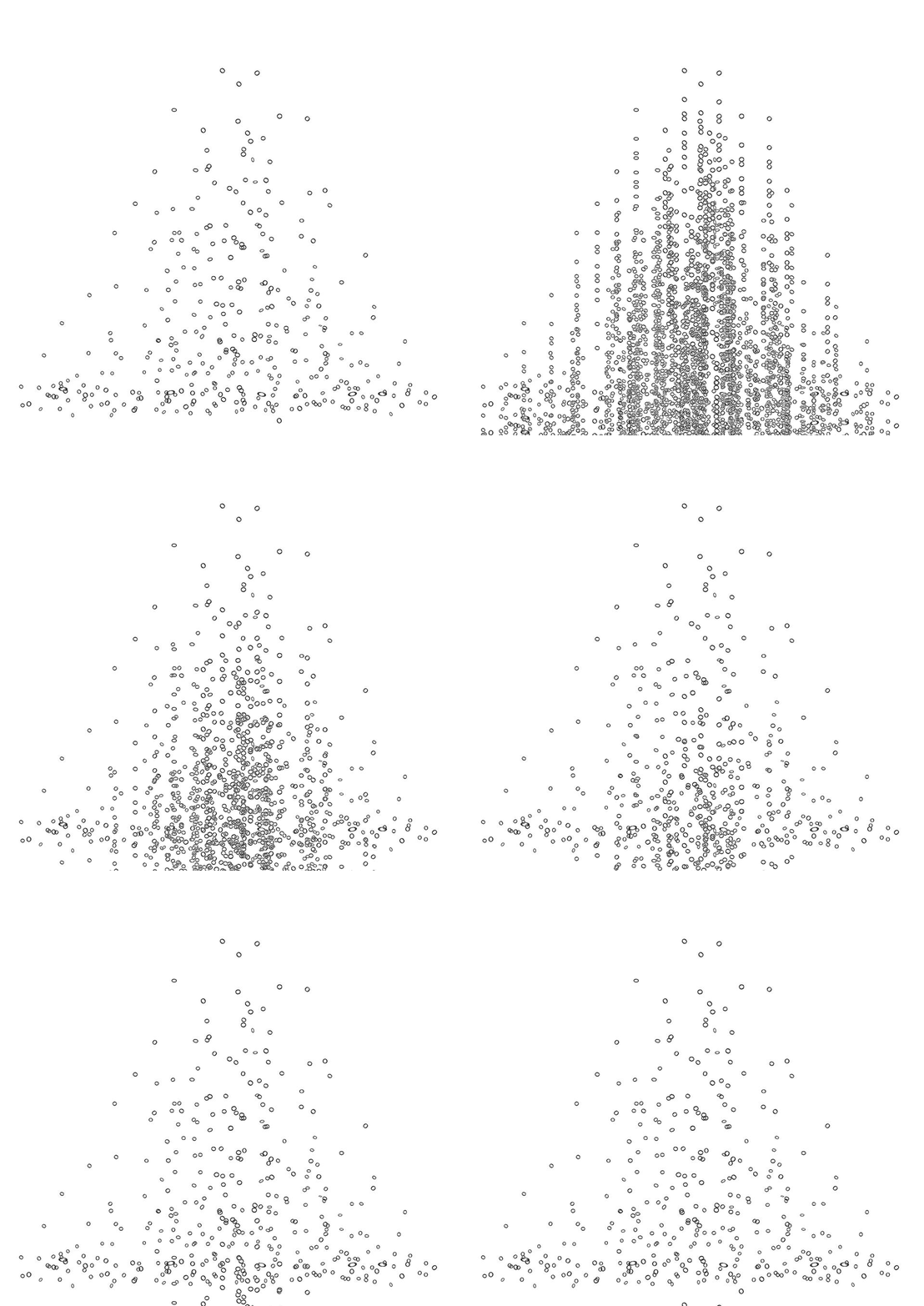
A later-career digital piece, The Letter O is unique within Copithorne’s canon, standing apart from both her earlier analogue works and her later digital output—almost a “one-off,” if you will. The serpentine linear elements present in her early analogue works and later digital works are replaced here by a roughly triangular, cloud-like arrangement of 361 letter Os, appearing to float downward toward the base of the form. Gone are the “body-like,” hand-drawn organic elements of her earlier works, replaced instead by a grapheme-dominated space that is both full and simultaneously empty.
This paradox of full-emptiness (or empty-fullness?) creates both formal and metaphoric tension, embodied in the letter Os themselves, each defined by a hole—a space of nothingness. Yet en masse, these graphemes give The Letter O its density and mass. And while a triangular form can, in the wrong hands, feel rigid or contained, Copithorne’s deft compositional distribution of the Os suggests space and movement rather than containment. The eye ambles through the voids at the centres of the graphemes and the spaces between them, creating a kind of spatial choreography. The result is a sense of infinite movement through space.
In 2017, I had the pleasure of chatting with Judith about her work. What inspired me most was her comment that she didn’t think of herself as “writing,” and that her primary interest lay in the space(s) between writing and visual art. For Judith, the interstitial space between visual and literary practices was a rich site for exploration and play. While The Letter O features no words—consisting “only” of 361 letter Os—it is nevertheless pregnant with meaning potential, residing in the depths of its spaces and the movement across its aesthetic surface, as well as in the mind and heart of the viewer/reader.
As snow drifts down in my backyard while I type these final sentences about Judith’s gift to us all, I take one last look at the playful drift and lilt of her letters. Like seeds on a breeze or drops of rain, they trace a patient and playful path through an imaginary space oscillating between my computer screen and myself. In a masterful turn, Judith maps—through the use of a single letter-form—an infinite field of possibility. In doing so, she creates a literary object whose internal space is larger than its exterior… like all good poems, perhaps?
In parting, I’ve shared below a .gif(t) animation of The Letter O that I created for Judith back in 2017. When she allowed me to enter the space of her work at that time (an early example of my foray into simple digital time-based visual work engaging with visual poets), I had no idea how significant a preoccupation working with moving images would become. Her generosity and willingness to share her creative space continue to move me deeply to this day.
NOTE: Visit this link to see a full-resolution of the .gif animation below.
https://aureolestudios.com/Copithorne3.gif
https://aureolestudios.com/Copithorne3.gif
NOTE: See this article by Eric Schmaltz at Canadianpoetry.org where he refers to and expands on the above mentioned body-like elements as discussed by Gregory Betts.


Comments
Post a Comment